The history of the famous American naval shipwreck of Okinawa
The battle of Okinawa, also known as Operation Iceberg, was the largest and bloodiest of the Pacific War fought from April 1st to June 22nd 1945 and resulted in over 250,000 deaths from American and Japanese military as well as Okinawan civilians. The Allied forces amassed one of the most powerful naval forces in history which included over 1,600 ships and 350,000 personnel. The Japanese, facing depleted resources, relied heavily on kamikaze suicide attacks sinking a total of 36 ships and damaging 368 more. Notable incidents included the destroyer USS William D. Porter (10th June), minesweeper USS Swallow (22nd April), minesweeper USS Emmons (6th April) and destroyer USS Mannert L. Abele (12th April). The famous Japanese Yamato battleship, which was the largest battleship ever built, was also intended as a kamikaze vessel but never made it to Okinawa when it was shot down by American aircraft on April 7th 1945 in the East China Sea.
Okinawa island is surrounded by the wreckage of these ships, only a handful of which have been located, primarily by private groups. The USS Dexler, USS William D. Porter and USS Mannert L. Abele were all discovered by the Lost 52 project in the last 4-6 years, within 1.3 to 3.8km of water. The approximate location and depth of the USS Swallow is known (around 155m, west of the Kerama Islands) but the current status of the wreckage is unknown with no documented dives or archeological surveys. However, the USS Emmons was discovered over 50 years after it sunk in 2001, and due to its depth of 45m it is the only one of these wrecks accessible by both recreational and technical divers alike.
USS Emmons History
As the last naval fighting ship to be commissioned (on 5th Dec 1941) before the US entered the second world war, the USS Emmons (DD457/DMS22) had an impressive history before its final stand during the battle of Okinawa, only four months before the surrender of the war. Initially working as a Gleaves-class destroyer, the Emmons fought during the invasion of Normandy as well as southern France, guarded British ships from German attacks in Norway, carried President Franklin D. Roosevelt to the infamous Teheran Conference before being converted in 1944 to serve as a minesweeper and tasked with clearing underwater mines in Okinawa’s coastal waters. During the Battle of Okinawa, the USS Emmons was struck by five kamikaze suicide planes simultaneously. The result was a desperate and losing struggle for damage control with 60 dead and 77 wounded. The rest of the crew abandoned ship and on the morning of the 7th April, her sister ship, the USS Ellyson, sunk the Emmons by gunfire to prevent it falling into enemy hands.
USS Emmons Dive Site
Location: North side of Kouri Island
Depth: 34 to 45m
Length: 106m
Pre-requisites
Available to both recreational and technical divers, this article focuses on the former. Minimum advanced open water certification is required, with nitrox and multiple cylinders being an advantage, and ideally around 50 logged dives. This dive site can experience strong currents, particularly on the surface, therefore divers need to be comfortable managing their gear and entering the water efficiently. Good buoyancy skills, gas management and knowledge of no-decompression limits are a must due to the deep nature of the site and the importance of safety and decompression stops on the ascent, with many dive shops requiring a check dive before they agree to guiding at the Emmons.
The Dive
The USS Emmons is around a 20 minute journey from Kouri Island port, using local fisherman owned boats. For the recreational diver, dives are often short (25-30 minutes) due to the depth. The site has several descent lines in order to locate the wreck and to also maintain group control in currents. Visibility is usually excellent and as the group begins their descent, the wreck’s silhouette gradually emerges from the blue. Trips often include two dives with each dive exploring a different section of the 106m long ship. Short bottom times means that guests usually want to return multiple times to feel like they have fully explored the whole site! Ascent procedures involve multiple safety stops, following the dive guide and using the same descent lines. The boat returns to the port each dive so that groups can ensure they have a long (and comfortable) surface interval in the interests of safety.
Highlights
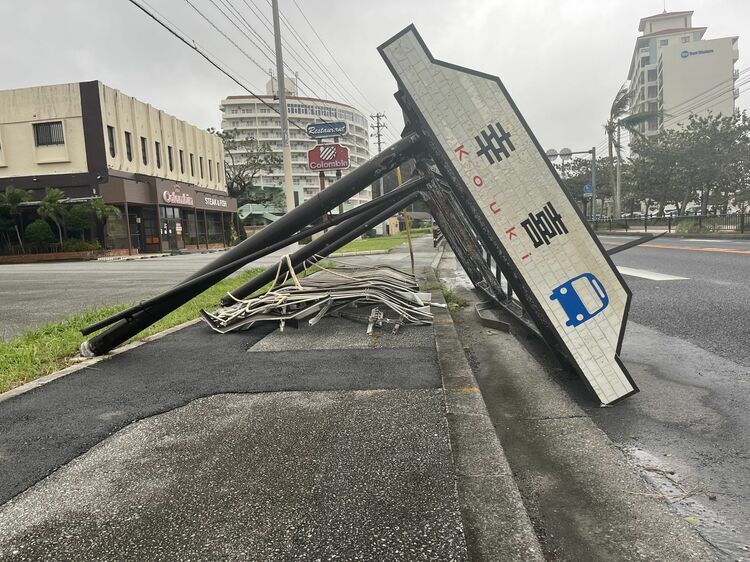
As divers descend down to the wreck, her twin stacks and forward gun turrets are the first to become visible. Despite recurring typhoons, the Emmons still maintains impressive structural integrity and although allowed, penetration by certified divers is discouraged as the site is preserved as a memorial. Extensive battle damage from kamikaze planes can be viewed along the entire length of the ship, with the most dramatic around the port side. Remnants of one of the kamikaze planes, including its engine, can be viewed on the sea floor to the north-east. Nutrient-rich waters have led to remarkable coral growth, primarily encrusting stony coral colonies (surprising given the depth) and with the wreck's position along migration routes, pelagic activity is often seen around the hull. Very tiny oil bubbles can also be seen emerging from holes in the main deck from an internal leak. Caution should be taken though when diving around the site as there are several unexploded depth charges remaining including six in the hull and two others on the seabed. These would have been used to attack submarines and removal poses a challenge due to technical capabilities, the desire to maintain the ship as a naval ruin and the fact that even though the wreck is located in Japanese waters, it still belongs to the US.
The massive structure, dramatic scenes and historical significance makes the USS Emmons an iconic wreck dive in Okinawa. A challenging but impressive dive that serves as a somber reminder of sacrifices made in war.
Interested in exploring this unique piece of history? We cater for both recreational and technical divers, so book your dives with Teal Orange today!
References:
Okinawa: The Final Battle | National Museum of the Pacific War
Battle of Okinawa: Date, Significance & Who Won - HISTORY | HISTORY
Operation Iceberg: The Battle for Okinawa | The National WWII Museum | New Orleans
Battle of Okinawa | Map, Combatants, Facts, Casualties, & Outcome | Britannica
What Happened to the Yamato and Where Is It Now? - ScienceInsights
Lost 52 Project | New York, NY 10028
The Gallant Destroyers of D-Day | Naval History Magazine - June 2004 Volume 18, Number 3
Pacific Wrecks - USS Emmons DD-457 (DMS-22)
USS Emmons (DD-457, DMS-22) Last Day of the Emmons by Ernie Herr
Billingsley's History of the Emmons | ussemmons
USS Emmons Dive Site Guide | Japan
USS Emmons | Scuba Diving Guide | Underwater Atlas
Okinawa: Bombs found on sunken U.S. warship - The Japan News