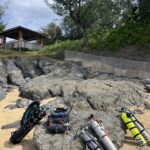
Market Size, Challenges, and the Future of Technical Diving in Okinawa
If Okinawa is on your shortlist for a diving trip, there's something you should know before you book your flights.
Okinawa is famous around the world for its crystal-clear water, coral reefs, and recreational scuba diving. But very few divers know that Okinawa also has enormous potential for technical diving, including CCR, sidemount, DPV, decompression diving, and trimix.
So why isn't Okinawa already known as a technical diving destination?
This article shares the current reality of the technical diving market in Okinawa—from someone building that community on the island.
"There Is No Technical Diving Market in Okinawa"
That was something an American friend told me.
He had lived in Okinawa for more than 15 years, owned a boat in a local fishing harbor, and regularly organized dives for military divers based in Okinawa. He was a CCR decompression diver, a technical-diving-friendly boat captain, and someone who understood the local diving scene well.
His comment stayed with me.
But after spending years diving and teaching here, I think the reality is a little different.
How Big Is the Technical Diving Market in Okinawa?
As of August 2026, only a handful of dive shops on Okinawa's main island are capable of regularly organizing technical dives.
Simply owning twinsets and stage cylinders doesn't necessarily make a shop a technical diving center. For this article, I'm referring to dive centers that can consistently support technical diving operations.
That includes shops that can provide:
- CCR decompression diving support, including Sofnolime.
- Twinsets, sidemount cylinders, and stage/deco cylinders.
- Oxygen boosting and partial-pressure gas blending.
- Trimix fills using helium.
- Guided dives and training in both sidemount and doubles.
A few shops can even lead full cave dives in both CCR and open circuit, although some operate only for Japanese-speaking divers.
In reality, there are probably:
- 1–2 shops capable of supporting cave and advanced technical diving.
- 2–3 additional shops capable of organizing open-water technical diving.
The supply is extremely limited.
How the Okinawa Diving Industry Actually Works
One thing many visiting divers don't realize is that Okinawa's diving industry operates very differently from many other destinations.
It is built around three different businesses.
1. Dive Shops
Most dive shops don't own boats.
In Okinawa, it's relatively easy to register a dive business without having a storefront. Many instructors operate small dive centers from home.
2. Cylinder Delivery Companies
More than 90% of dive shops rent cylinders from specialized delivery companies.
The standard setup is usually Japanese steel 10L cylinders with yoke valves. This system works well for recreational diving but isn't designed around technical diving logistics.
3. Local Fishing Boat Captains ("Uminchu")
Most boat diving is operated by local fishermen.
Each harbor has its own captains and designated dive areas. For example, boats operating from Seragaki Harbor in Manza won't normally travel to the USS Emmons wreck in northern Okinawa.
Every harbor has its own territory, schedule, and local relationships.
Understanding this system is essential when planning technical dives.
How Technical Diving Is Done in Okinawa
Technical diving in Okinawa usually happens in one of three ways.
Shore Technical Diving
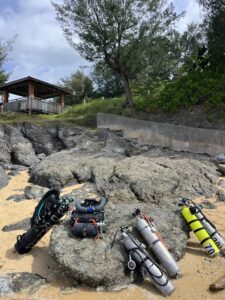
The west coast of Okinawa's main island offers several excellent beach entry sites.
Some locations are extremely shallow for a long distance, making DPVs (Diver Propulsion Vehicles) highly recommended for reaching deeper water efficiently.
Long-range shore dives can easily exceed two hours while keeping costs much lower than chartering a boat.
Private Boat Charters
Chartering a local fishing boat gives technical divers complete flexibility for dive planning.
The downside is cost.
Most charters range between ¥60,000 and ¥90,000, because prices are based on what recreational dive shops would normally earn from a shared recreational boat.
Shared Recreational Boats
This is probably the most unique option in Okinawa.
At selected sites, technical divers can enter the water with recreational divers during the first dive and stay underwater through the recreational surface interval.
This allows dive times of 90–120 minutes while everyone exits together after the recreational group's second dive.
It only works with good planning—and good relationships with local boat captains.
Currently, there are no dedicated technical diving boats operating regularly on Okinawa's main island.
Maybe the Problem Isn't Demand. It's Supply.
The phrase "there is no technical diving market in Okinawa" sounds more negative than reality.
I think the market looks more like this:
Recreational Diving
Demand: ████████████████████
Supply: ████████████████████
Technical Diving
Demand: ███
Supply: █
CCR / DPV / Cave Diving
Demand: █
Supply: ▏
The issue isn't that nobody wants technical diving.
The issue is that very few businesses are equipped to provide it.
Yes, technical diving is a niche market.
There are thousands of divers searching for "diving in Okinawa."
Far fewer are searching for "TDI Decompression Procedures Okinawa."
But those divers exist.
The Bigger Challenge: Divers Don't Know It Exists
I believe awareness is actually the biggest challenge.
Many experienced divers simply don't realize that Okinawa offers:
- Deep wreck diving.
- Technical sidemount diving.
- CCR diving.
- DPV exploration dives.
- Trimix diving.
- Technical training from Advanced Nitrox through decompression procedures.
When divers think of Okinawa, they think of coral reefs and turtles—not decompression diving.
That perception is slowly changing.
Why Okinawa Has Huge Potential
I honestly believe Okinawa has enormous potential as a technical diving destination.
The ocean here is already world-class.
The visibility, warm water, few caves, deep walls, wrecks, and long coastline create incredible opportunities for experienced divers.
The next step isn't changing the ocean.
It's improving the infrastructure around technical diving.
That means:
- More affordable options than full-day private charters.
- Reliable helium and oxygen supply.
- Better access to nitrox membrane systems.
- Facilities and classrooms designed for technical training.
- Affordable accommodation for multi-day technical courses.
- A community where technical divers can connect and dive together regularly.
These improvements would make Okinawa significantly more accessible for technical divers visiting from Japan and overseas.
The Future of Technical Diving in Okinawa
Technical diving in Okinawa is still a small community.
But every year, more divers travel here looking for something beyond recreational diving.
The opportunity isn't to become the biggest dive destination in Japan.
It's to become one of the best places in Asia for thoughtful, high-quality technical diving.
We're excited to be part of building that future.
And we hope to dive with more technical divers from around the world in Okinawa.